
The Centre has advised banks to make a 20 per cent reduction in expenditure related to non-core business activities, along with deferring "avoidable expenditure" on "purchase of staff cars", "refurbishment of guest houses" and on the interior decoration of administrative and back offices.

The firm, headed by Sunil Kumar Gupta, was appointed auditors of the PM's National Relief Fund in 2019, reports Archis Mohan
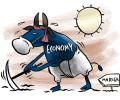
'A proposal to do away with labour laws is not feasible.' 'That's why we wanted to have a dialogue with the states.'
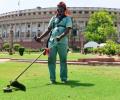
Officials have said the national capital lacked a convention centre big enough to seat so many MPs and adhere to social distancing norms. Additionally, holding a 'virtual session' looks slims as any change in the rules requires a motion to be carried in both the Houses of Parliament.
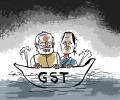
Retaining the GST rate assumes importance since states are under pressure to increase their revenues, hit hard by lockdown. Also, the Centre has not fully compensated states for their revenue losses on account of GST for 2019-20.

ILO acts upon a plea by 10 central trade unions objecting to the ordinances proposed to temporarily scrap labour laws in Uttar Pradesh and Gujarat, along with executive orders issued by at least 10 states to increase the daily working limit to 12 hours from eight hours, along with other labour law changes.

Labour law changes for three years may not be enough as it takes a couple of years for factories to build and operations at a proper scale start only in the third or fourth year.
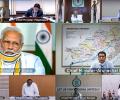
'The spirit of cooperation between the Centre and states has been diluted in many ways.' 'The level of consultation which used to be there earlier has reduced significantly.'
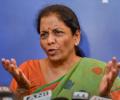
The government was going in the "wrong direction" and it was "highly condemnable" that it did not discuss the proposed changes with trade unions and other stakeholders, says BMS, trade union arm of the RSS.
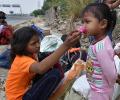
There was no announcement from the government on guaranteeing a minimum basic income, which is the need of the hour. The announcements on portability of ration cards and affordable rental housing to workers are for the long and medium terms. Migrant workers need immediate relief.

The Karnataka government is also expected to follow suit and withdraw its decision to raise the variable DA.
During his interaction with the chief ministers, Prime Minister Narendra Modi assured that more economic activities would resume; he also said that zone identification may be left to the states.
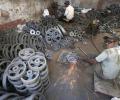
11 categories of industries will be exempt from the Madhya Pradesh Industrial Relations (MPIR) Act of 1961. This includes textile, leather, cement, iron and steel, electrical goods, sugar, electricity, public motor transport, engineering including manufacture of motor vehicles, among others.

'Just as coronavirus has come to us from China, this disease is also coming from that country.' 'India is a strong democracy and you cannot compromise on labour laws in this manner.' 'These changes will be challenged in court.'
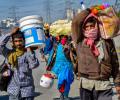
Unlike the other Bharatiya Janata Party-led governments, Assam has not proposed doing away with most labour laws for a certain number of years. Instead it has proposed introducing fixed-term employment to help both workers and industries, and seeks to take more firms out of the ambit of laws governing factories and contract workers.
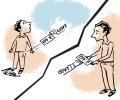
Apart from this, employers may be allowed to deduct EPF contributions only on the basic pay of up to Rs 15,000, even if the employees' basic pay is above this ceiling. While on one hand this will allow companies to lower their wage bills, employees can also get a higher salary in hand.
The portal, which has been tentatively named by the labour and employment ministry as the National Portal for COVID-19 Affected Unorganised Migrant Workers, will gather the details of all the unorganised sector workers who are stranded in relief camps, residential or industrial clusters.
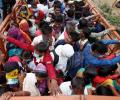
Parliamentary standing committee on labour, led by Biju Janata Dal MP Bhartruhari Mahtab, has said in its report that it is unjustifiable for owners to pay workers' wages during natural calamities.
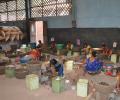
Ensuring health insurance for all workers would be major challenge for the industry that is already grappling with cash crunch, and the government should have borne the cost.
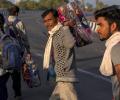
Daily wagers are running out of resources, including ration and cash, and the state governments might not be able to sustain their needs for a longer period of time, given the lockdown has already been extended until May 3.
 © 2026 Rediff.com - Investor Information - Advertise with us - Disclaimer - Privacy Policy - Sitemap - Feedback - About us - Terms of use - Grievances